
How the Book of Mormon was written back into Egyptian
The project began with one question: what do the names in the Book of Mormon mean? Either they mean something, or they were invented. That is testable. Every reading here is checkable: a published Egyptian name, a citation, a count.
1. The names first
Strip a name to its consonants and match them, under Muchiki’s equivalence classes, against the names real Egyptians bore. Prefer a whole attested personal name with known bearers. Where a name is built from a god and an element, read it the way Egyptians wrote it, god first: Lehi is Rꜥ-Ḥr.j, Laman Rꜥ-Jmn, Mormon Mr.jj-Jmn, “beloved of the Hidden One.”
| Class | Rule |
|---|---|
| r = l | Egyptian has no l; Hebrew l is heard as r. Alma = Rꜥ-Mꜣꜥt. |
| s = z = š | the sibilants |
| k = q = g = ḫ = ẖ | the velars |
| t = d = ṯ = ḏ | the dentals |
| b = p = f | the labials |
| h = ḥ | the aspirates |
| ꜣ ꜥ j y w | weak letters, which may drop out |
A short name in -i or -y is often the Egyptian pet-name ending -j / -jj: Nephi is Nfr.j, Omni Jmn.jj. In the Mainz corpus 544 distinct names end this way, carried by 7,525 people. When no name fits, an attested Egyptian word that matches the sound and suits the place is used (Bountiful is Bj.t, honey; Deseret Dšr.t, the Red Crown). When nothing fits, the consonants are spelled sign by sign and the reading is labelled phonetic.
2. The Godhead
The Egyptian divine council mirrors the Godhead the names describe. Heavenly Father (El) is Ra; Jehovah is Iah, the moon; Jesus Christ is Shu; the Holy Ghost is Amun, the Hidden One; Adam is Atum, Eve is Ḥw.t, Satan is Set. A Hebrew name in -el therefore carries Rꜥ, and one in -iah carries Jꜥḥ.
3. What the names were checked against
| Source | Published | Held and searched |
|---|---|---|
| Ranke, Personennamen | 1935, 1952 | 13,351 entries counted |
| TLA (Berlin) | online | 4,406 personal names |
| Mainz PNM | 2018–2025 | 7,933 names; 53,447 persons |
| Demotisches Namenbuch | 1980–2000 | 9,139 entries |
| AGÉA (IFAO) | 2011 | 1,772 entries |
| Deir el-Medina Database | online | 1,437 names |
| Trismegistos Places | online | 65,053 places |
| Royal and place inscriptions | — | cited from publications |
| Museum objects, Karnak | — | 1,265 statues; 1,222 Karnak refs |
| Muchiki, sound rules | 1999 | 724 index entries |
| Literary and religious texts | — | cited |
226 of the 334 names are cited in three or more of the six name catalogues. Ordinary Hebrew names found a sound-match (71%) at least as often as Book of Mormon names (68%): a match alone proves little, so the meaning and the story on each name’s entry must carry it.
4. The Caractors and the script
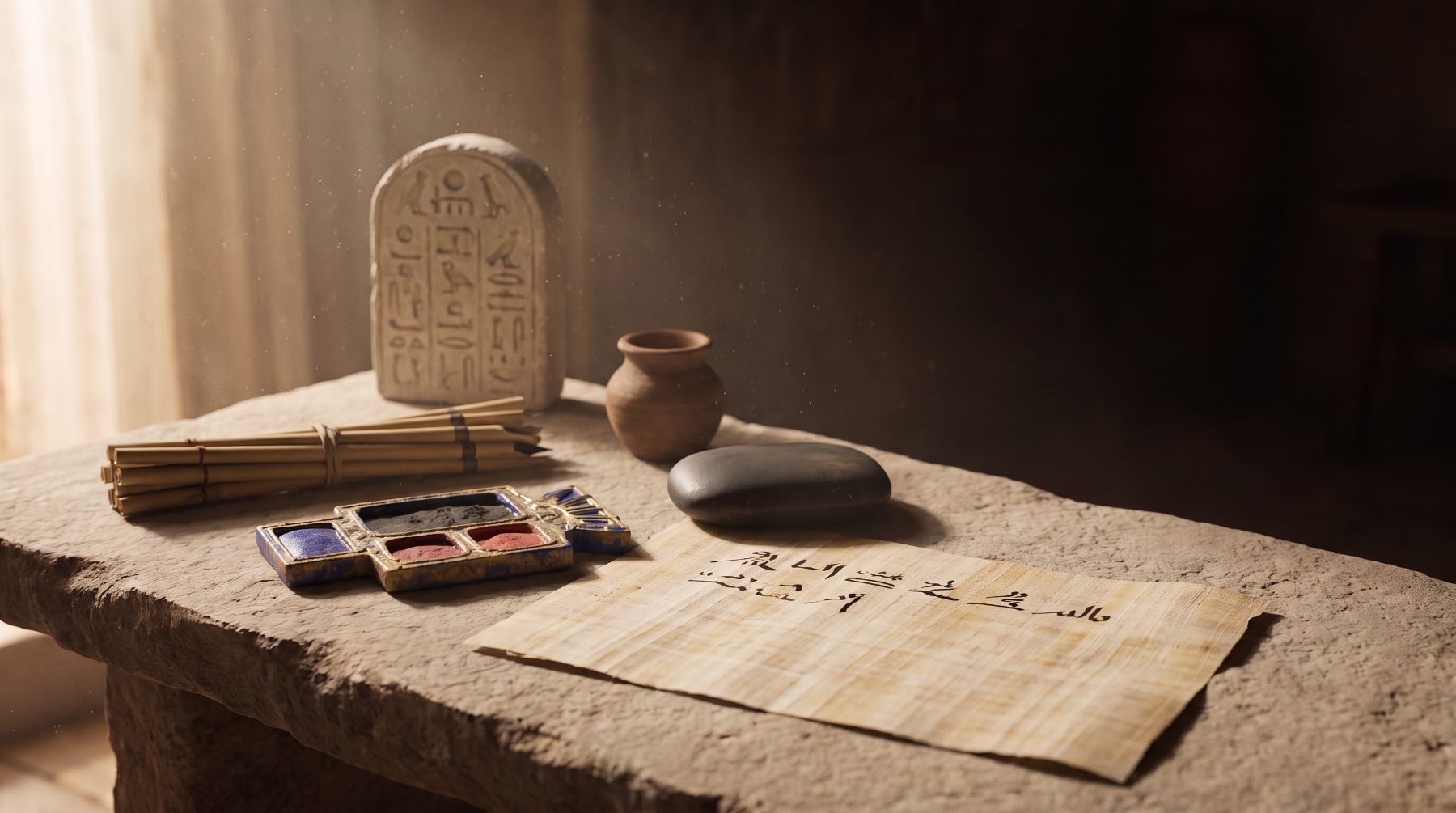
The Caractors document (the John Whitmer copy) is seven lines of characters copied from the plates. Its signs were tested against 34 sign sets: 4,666 Demotic signs from about 260 papyri, 3,599 Saite drawings from AKU-PAL, 85 Saite documents. The reading settled on 26th-Dynasty Saite hieratic. The books are then written in the Caractors’ own characters wherever the sheet has the word (black), in Saite hieratic for the rest (grey), and in a printed hieroglyph where no Saite drawing exists (light grey). The numbering characters 3, 4, 5, 7 and 8 are built from the sheet’s own 9 (light blue).
5. The translation
Each verse is rendered into Late Egyptian as a Saite scribe would phrase it, faithfully and in order. Settled grammar: “and it came to pass” is ꜥḫr, as on line 4 of the Caractors; narrative “and he said” is jw=f ḥr ḏd; “shall” is the Third Future jw=w r; “behold” is ptr. Spellings come from attested Late Egyptian in the Thesaurus Linguae Aegyptiae, or the standard dictionary where the corpus lacks a word. Nothing is invented: where Egyptian lacks a concept, the substitution is stated on the page and in the chapter’s findings.
Every page shows six rows: how to say it, the BOM hieratic, the hieroglyph, the transliteration, the English word, and the grammar. Each chapter ends with its findings.
6. The Old Testament
The same method was then applied to every Old Testament name: 3,015 names, titles and peoples. 162 come straight from the Book of Mormon deck and are settled. The rest are provisional, graded strong, moderate, weak or phonetic, and are under review. The Old Testament volumes render from those keys, so a name reads the same in Genesis as it does in 1 Nephi.